India signs first ever TOR (Terms of Reference) Navy Agreement with Australia


India and Australia on Wednesday inked the ‘Terms of Reference’ (ToR) for the conduct of the navy to navy talks under the framework of the ‘Joint Guidance for the India - Australia Navy to Navy Relationship’ document.

In June last year, India and Australia elevated their ties to a comprehensive strategic partnership and signed a landmark deal for reciprocal access to military bases for logistics support during an online summit between Prime Minister Narendra Modi and his Australian Counterpart, Scott Morrison. The Mutual Logistics Support Agreement (MLSA) allows militaries of the two countries to use each other’s bases for repair and replenishment of supplies, besides facilitating scaling up of overall defence cooperation.
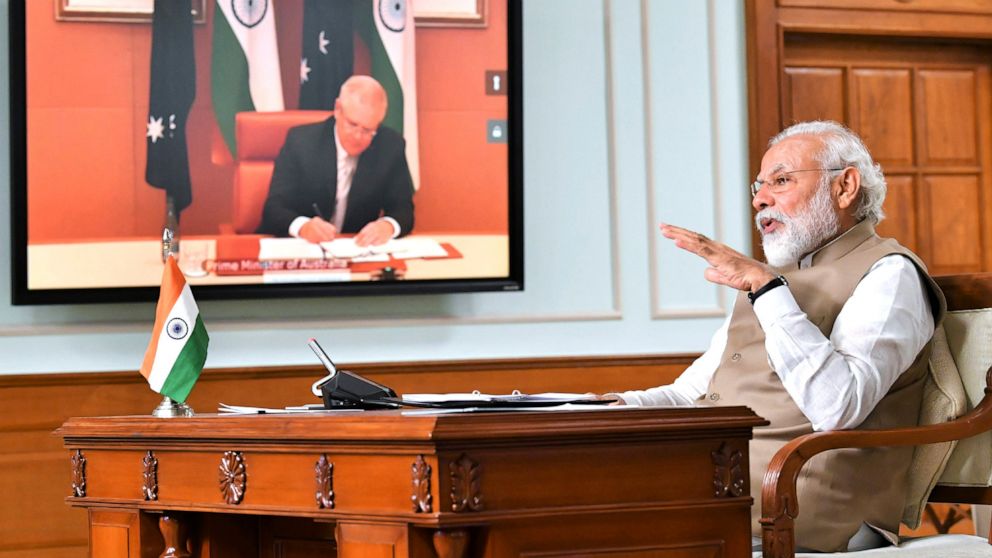

"The document would be pivotal in consolidating the shared commitment to promote peace, security, stability and prosperity in the Indo-Pacific region,"

The ToR set out the broad objective of achieving deeper mutual understanding, trust and transparency, improved goodwill and understanding of each other’s concerns and future directions, and provides detailed guidance for the conduct of the bilateral talks. They also provide flexibility for implementation of separate agreements based on the specific outcomes of the talks.

This is the first such document signed by the Indian Navy with any country. The signing ceremony was held virtually between Rear Admiral Jaswinder Singh, of the Indian Navy and Rear Admiral Christopher Smith of the Royal Australian Navy.


The two navies had on August 18 signed a document titled ‘Joint Guidance’ to expand cooperation. “Consequent to the signing of ‘Joint Guidance for the India-Australia Navy to Navy Relationship’ document by the Chiefs of the Indian Navy and the Royal Australian Navy on August 18, the ‘terms of reference for the conduct of Navy-to-Navy Talks between the Indian Navy and the Royal Australian Navy’ was signed on September 29," the defence ministry said in a statement.

The ‘Joint Guidance’ document sets the Navy to Navy talks as the principal medium for guiding the bilateral relationship, the Indian Navy said. The document was signed by the Navy chiefs of both nations in August this year.

It said the document would be pivotal in consolidating the shared commitment to promote peace, security, stability and prosperity in the Indo-Pacific region.

Under this document, Navies of both the countries will try bring parity in the way they operate and the code language they use while giving signals. It is a truth that China has made significant growth with their navy in the Indian ocean which poses a threat to free and stable Indian Ocean. This will help both the countries to fight together if in future any threat comes their way. This will also help India to increase its influence in the Indian Ocean and to counter increasing influence of China in the region.

Comments

Popular posts from this blog

United Kingdom wants trade and Security pact with India and other democracies

With the changing world demographic's the significance of Indo-Pacific is increasing significantly. On 3rd October Britain's new new Foreign Secretary Liz Truss said, "The UK wants to get into agreements covering trade and security with India and other freedom-loving democratic countries in the strategic Indo-Pacific', to challenge the authoritarian states. Liz Truss was also in charge of talks with India on a future Free Trade Agreement (FTA) as the International Trade Secretary until her recent promotion within the UK Cabinet, She said that she is keen to strike more deals along the lines of AUKUS - the trilateral security alliance between Australia, the UK and the US, which is widely seen as a counter-balance to China. In her first major interview after she took charge as New Foreign Secretary she mentioned "We want to work with our friends and allies to create more economic agreements and security agreements. AUKUS is about protecting trade routes and shippi...

China reunification with Taiwan ‘must’ be fulfilled: Xi Jinping

China's President Xi Jinping has said that "reunification" with Taiwan "must be fulfilled", as heightened tensions over the island continue. Mr Xi said unification should be achieved peacefully, but warned that the Chinese people had a "glorious tradition" of opposing separatism. In response, Tsai Ing-wen president of the Republic of China (Taiwan) said "we will not bow to Beijing pressure and our future lay in the hands of our people". Taiwan considers itself a sovereign state, while China views it as a breakaway province. Beijing has not ruled out the possible use of force to achieve unification. Mr Xi's intervention comes after China sent a record number of military jets into Taiwan's air defence zone in recent days. Some analysts say the flights could be seen as a warning to Taiwan's president ahead of the island's national day which is on 10th of October. Taiwan's defence minister has said that "tension...

USA eyes military bases in India

The United States has subtly hinted that it has been in talks with New Delhi for using airfields in India as “staging areas” for carrying out aerial surveillance and launching attacks on terrorists in and around Afghanistan.  President Joe Biden’s administration is “deeply engaged” with New Delhi, the US Secretary of State, Antony Blinken, said, testifying before the Foreign Affairs Committee of the House of Representatives – the lower house of the American Congress. In the strategic circles in both the US and India, there are now more voices favoring the idea of India providing a military base to the US Navy, preferably somewhere in the Andaman and Nicobar group of islands. Since the US Navy is said to be planning to deploy 60 percent of its surface ships in the Indo-Pacific, it wants safe territories in or the adjoining Arabian Sea, Andaman & Nicobar, and the Bay of Bengal for refueling and other logistic support. In fact, the Pentagon has been looking for base opportunities...