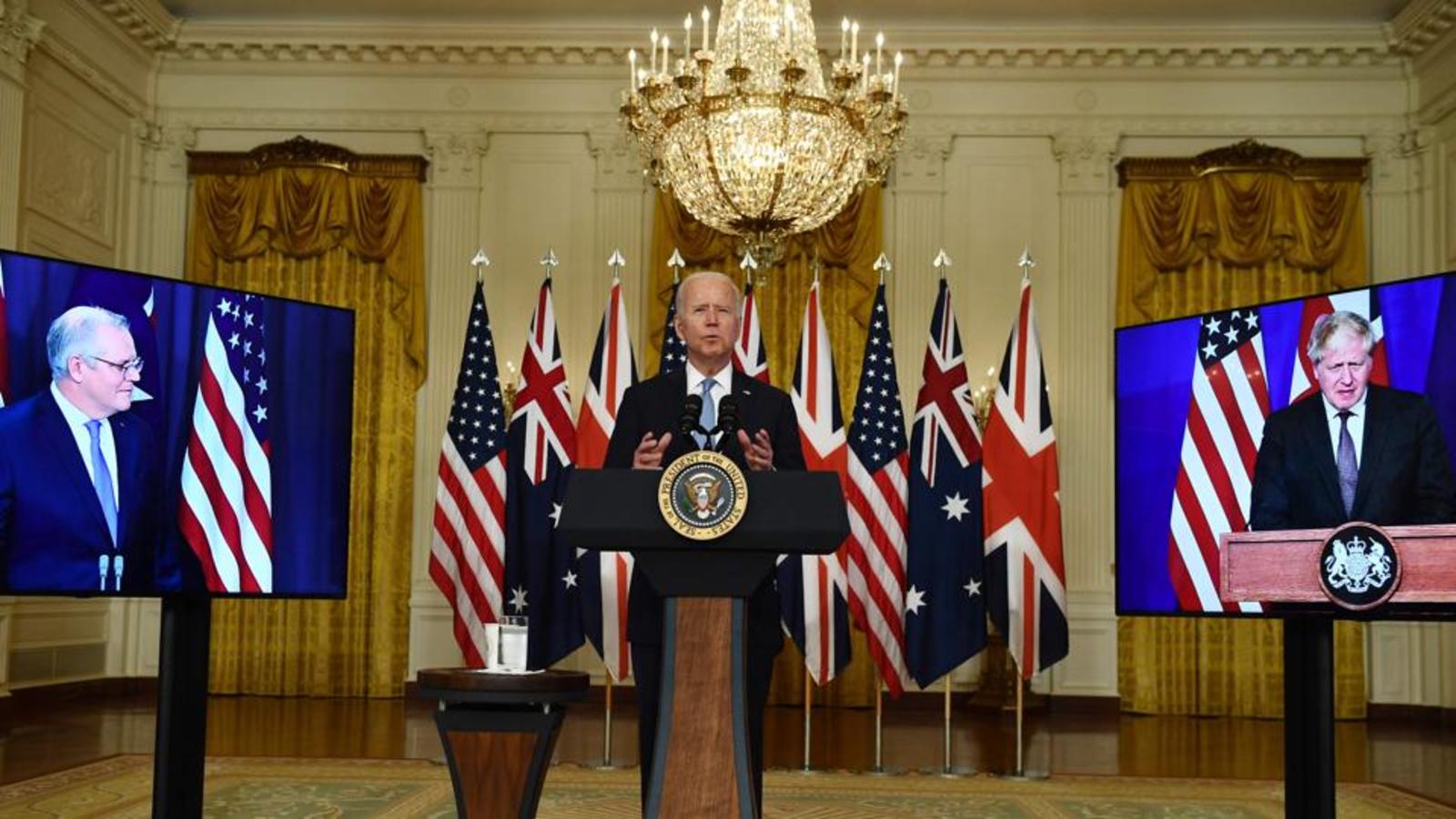
The United States, Britain and Australia said on 15/Sept/2021 they would establish a security partnership for the Indo-Pacific that will involve helping Canberra acquire nuclear-powered submarines, as Chinese influence over the region grows.
The US,
the UK and Australia have announced they are setting up a trilateral security
partnership aimed at confronting China, which will include helping Australia to
build nuclear-powered submarines. US President Joe Biden, UK prime minister
Boris Johnson and Australian prime minister Scott Morrison announced the deal together
virtually.
Biden,
British Prime Minister Boris Johnson and Australian Prime Minister Scott
Morrison appeared together virtually to detail the new alliance, which will be
called AUKUS (pronounced AWK-us). The three announced they would
quickly turn their attention to developing nuclear-powered submarines for
Australia.
The
agreement is reported to cover key areas such as artificial intelligence, cyber
warfare, underwater systems, and long range strike capabilities.
It is
also reported to include a nuclear component, possibly limited to United States
and United Kingdom, on Nuclear Defense Infrastructure.
Unveiling
the ambitious security initiative, US President Joe Biden, UK Prime Minister
Boris Johnson and his Australian counterpart Scott Morrison in a joint
statement said their move will promote stability in the Indo-Pacific and
support of their shared values and interests.
Under
the first major initiative of AUKUS, Australia would build a fleet of
nuclear-powered submarines with the help of the US and the UK, a capability
aimed at promoting stability in the Indo-Pacific region.
In Beijing, the Chinese Foreign Ministry on Thursday sharply criticized the trilateral military partnership, saying it would closely monitor the pact that will gravely undermine regional stability and aggravate the arms race and hurt international non-proliferation efforts.
The new
security Alliance is likely to be seen as a provocative move by China, which
has repeatedly lashed out at Biden as he sought to focus US foreign policy on
the pacific in the early going of his presidency.
Washington
and its allies are looking for ways to push back against China's growing power
and influence, particularly its Military buildup, pressure on Taiwan and
deployments in the contested south china Sea.
Morrison
said the preparation for the deal would take 18 months. Given the lack of local
capability, Australia would need to "leverage expertise" from US and
UK "building on the two countries' submarine programs to build an
Australian capability into service at the
earliest achievable date".
Scott
Morrison said Australia was committed to "adhering to the highest
standards for safeguards, transparency, verification and accountable measures
to ensure the non-proliferation, safety and security of Nuclear Material and
Technology.
For
Nuclear Submarines, US will supply highly enriched uranium to Australia to
power the Submarines; Australia has reportedly agreed not to produce highly
enriched uranium itself.
The new
alliance, which will fast-track nuclear submarine development for Australia,
nullifies the Australia's pre-existing deal with France for Nuclear Submarines.
The
submarine contract was worth $36.5 billion.
France,
in a strongly worded statement, said the new deal was "contrary to the
letter and spirit of the cooperation that prevailed between France and
Australia.
When
asked for his reaction to the trilateral defence pact, Chinese Foreign Ministry
spokesman Zhao Lijian said: "The US, the UK and Australia are engaging in
a cooperation in nuclear powered submarines that gravely undermines regional
peace and stability, aggravate arms race and hurts the international
non-proliferation efforts".
"The US and UK are about to export highly-sensitive nuclear powered
submarine technology to Australia. This once again shows that they are using
nuclear exports for geopolitical gaming tools and applying double standards
which is extremely irresponsible.
"China
will closely monitor the situation. China always believes that any regional
mechanism must go with the trend of the times for peace and development and
should be conducive to mutual trust and cooperation between the regional
countries. They should not target any third party or harm third party's
interests.
The next
concern obviously is for countries like India, who are part of the Quad rouping
often referred to as Asia's NATO.
Experts
say, there are no reasons for India to be worried, as the new grouping pulls
UK- another major global power into the Indo-Pacific Cold war.
The AUKUS would compliment QUAD, and after the deal with Australia nullified, this will further push France closer to India as India is one of the biggest customer of Defense equipment made by France.
Comments
Post a Comment